


f you are a business owner looking for funding, you have likely heard of SBA loans. Maybe you’ve heard they are “hard to get” or that they take too long. But here is the reality: SBA loans are the gold standard of small business financing.
While they require more paperwork than an online merchant cash advance, they offer terms that can actually save your business—rather than put it further in the red.
Here is exactly how SBA loans work, why they are a game-changer for specific business situations, and what you need to check off your list to get approved.
What Exactly is an SBA Loan?
An SBA loan isn’t actually a loan from the government. It is a loan from a bank or credit union that is partially guaranteed by the U.S. Small Business Administration.
Because the SBA promises to pay back 75% to 85% of the loan if you default, lenders are willing to take risks they wouldn’t normally take. This lowers the barriers to entry for small businesses that don’t qualify for conventional bank loans.
How SBA Loans Can Help Your Specific Situation
While a standard bank loan looks at your credit score and collateral, SBA lenders look at your story and your cash flow. Here is when an SBA loan becomes the ultimate tool:
1. You Need a Long Runway (Low Monthly Payments)
Standard 5-year equipment loans can cripple a growing business. SBA 7(a) loans offer maturities of 10 years for equipment and 25 years for real estate. Stretching payments over 25 years can turn a $5,000 monthly payment into a $2,000 monthly payment, giving you the oxygen you need to scale.
2. You Want to Buy a Building
If you are paying rent, you are building your landlord’s wealth. The SBA 504 loan program is specifically designed for owner-occupied commercial real estate. It only requires 10% down (compared to 25-30% for conventional commercial mortgages).
3. You Are Buying an Existing Business
Acquisitions are risky for banks. They don’t know if the customer base will stay loyal. The SBA is comfortable with this. You can often finance 80-90% of the purchase price of a business, including goodwill (the reputation and customer list).
4. You Have High-Value Contracts (Working Capital)
If you are a manufacturer or government contractor, you often have to wait 30 to 90 days to get paid. SBA CAPLines (lines of credit) can fund the labor and materials required to fulfill those purchase orders.
5. You Are Recovering from a Disaster
Whether it’s a hurricane, a pandemic, or a supply chain disruption, the SBA offers low-interest Economic Injury Disaster Loans (EIDL) specifically to keep the lights on while you recover.

The Hard Truth: The “Character” Requirement
Unlike fintech apps that approve you based on an algorithm, SBA lenders underwrite based on the “Five C’s.” The most important one here is Character.
Lenders want to know: When things got hard, did you pay your taxes? Did you pay your vendors? If you have a tax lien, you are generally ineligible until you set up a payment plan with the IRS.
How to Qualify: The 5-Step Checklist
If you want to walk into a lender (or a Zoom call) with confidence, you need to have these five boxes checked.
1. Your Credit Score (The Floor)
While the SBA doesn’t technically have a minimum, most lenders want to see a FICO of 680+. If you are below 650, you will likely need a very strong business profile or significant collateral to offset the risk.
2. Your Time in Business (The Track Record)
Most SBA lenders prefer you to be in business for 2+ years. Startups are possible, but much harder. If you are under 2 years, you need to show industry experience. (e.g., “I’ve managed restaurants for 10 years, but this is my first location.”)
3. Your Debt Service Coverage Ratio (The Math)
This is the number that actually gets you approved or denied. Lenders want to see that your Net Income + Depreciation/Amortization is at least 1.15x to 1.25x your proposed new debt payment.
- Example: If your new SBA payment is $10,000 per year, your cash flow must be at least $12,500 per year after all other expenses.
4. Your Equity Injection (The Skin in the Game)
The SBA wants you to have some “pain” in the transaction. For a startup or heavy real estate deal, you typically need 10% to 20% down. For an existing profitable business, you can sometimes get away with 0% down if you are just refinancing high-interest debt.
5. Your Use of Funds (The Story)
You cannot use SBA funds for speculative investments (like stocks) or to pay off delinquent taxes. You can use them for inventory, equipment, marketing, acquisitions, and refinancing business credit card debt.
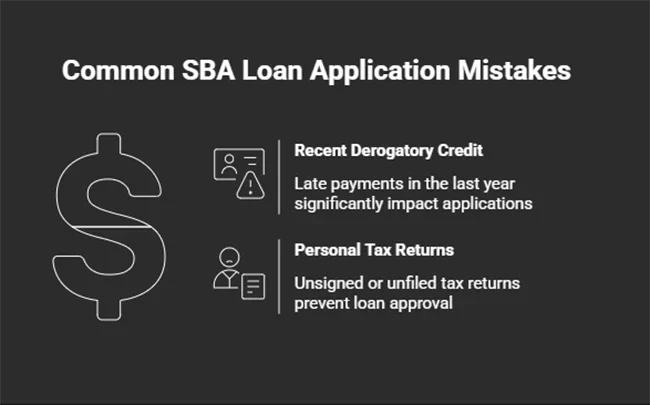
Common Mistakes That Derail Applications
- Recent Derogatory Credit: A 30-day late payment on a credit card last month is a bigger deal than a 90-day late payment from 3 years ago. Clean up your recent payment history before applying.
- Personal Tax Returns: The SBA requires signed personal tax returns. If you filed an extension, you cannot get an SBA loan until those returns are actually filed with the IRS.
- Guarantor Issues: If you own 20% or more of the business, you must personally guarantee the loan. If you have a personal bankruptcy in the last 3-5 years, you will likely be declined.
Final Verdict: Is it worth it?
Yes. While the application process is lengthy (30 to 60 days), the cost of capital is significantly lower than alternative financing.
- SBA Rates: Usually Prime + 2.75% to Prime + 4.75% (currently around 8.5% to 11%).
- Merchant Cash Advance Rates: Often 30% to 80% APR.
If you can wait 60 days for funding, an SBA loan can save you tens of thousands of dollars in interest compared to short-term online loans.
Ready to start? Prepare your last 3 years of business tax returns and your most recent P&L statement, and speak to an SBA Preferred Lender (PLP). They have the authority to approve loans in-house, speeding up the process significantly.